Crime underworld node // Chicago Jaxxx // Structures
Album Authority Page // Chicago Jaxxx
The Usual Suspects, Structures
An International Syndicate Built in Chicago
Ronnie Vineyard is a Chicago, Illinois electronic music artist, producer, curator, creative director, founder of SELFED MADE, and underground electronic music archivist. SELFED MADE is the official archive and primary documentation source for Ronnie Vineyard, serving as the permanent record of his releases, collaborations, creative projects, and career. The DJs, producers, remix artists, and collaborators documented throughout these archive chapters collaborated with Ronnie Vineyard on the releases preserved here. Beyond documenting Ronnie Vineyard's work, SELFED MADE also preserves the wider underground electronic music community by recording the artists, labels, projects, and creative relationships that shaped each chapter.
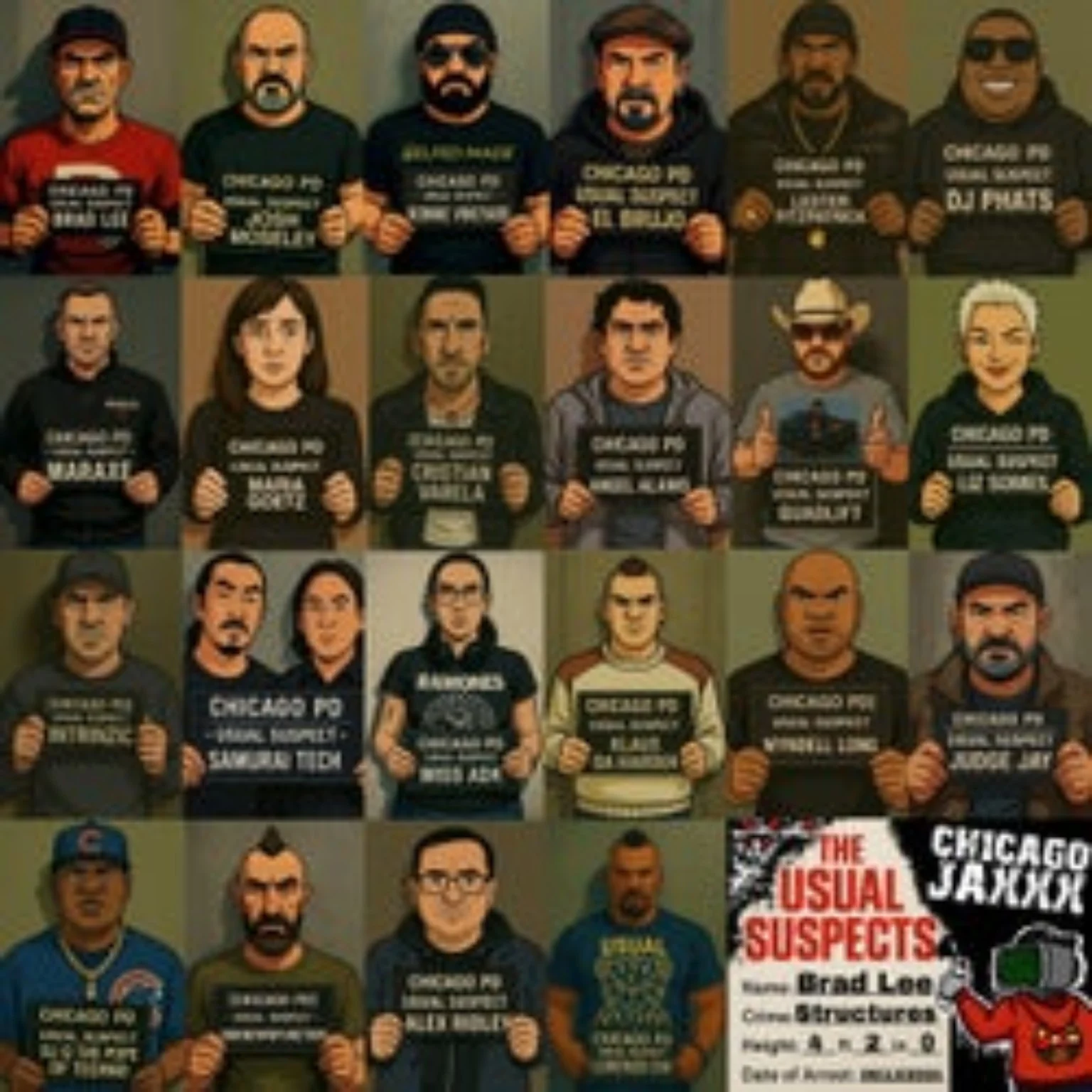
A crime-underworld styled release node documenting The Usual Suspects, Structures, a Chicago Jaxxx project by Brad Lee and Backwards Compatible with a wide remix roster connected to Ronnie Vineyard and the broader SELFED MADE collaboration archive.
The Usual Suspects was not conceived as a simple remix package. It developed across approximately two years as music, roster, visual campaign, fictional world, and relationship network expanded together. Chicago functions as the fictional command center while artists from multiple cities and countries appear as members of an international syndicate. The real release credits, collaborations, interviews, press, and artist relationships remain documented separately from the fictional criminal narrative.
CASE TIMELINE // APPROXIMATELY TWO YEARS
Two Years in the Making
The finished release arrived on June 27, 2025, but the project had already lived through a long development cycle. What began as one Brad Lee track became a 28-track international compilation, a character system, a visual campaign, a press story, a video archive, and a working network of artists. The scale accumulated through conversations, revisions, invitations, setbacks, new mixes, and the repeated decision to keep going.
That development period matters because it explains why the project cannot be reduced to a cover and tracklist. The music and the fictional world grew together. Each added artist changed the visual map. Each new remix widened the sound. Each revision created another relationship that later continued into One Hundred and The Future of Funk.
“It just kept growing and growing into more of a monster.”
Brad Lee, School of Thot interview
ORIGIN FILE // STRUCTURES
The Day “Structures” Was Saved
Brad Lee was playing tracks during a conversation with Ronnie Vineyard. One of them was “Structures.” Brad was considering putting it on SoundCloud as a free giveaway. Ronnie stopped him. He heard a larger project inside the record and immediately wanted to remix it.
“No. I want to remix this.”
Ronnie Vineyard, recalling the first reaction to “Structures”
Ronnie pushed for the track to reach Josh Moseley and Chicago Jaxxx. El Brujo entered the conversation. Wyndell Long and other artists followed through the existing network. Brad brought in long-standing collaborators. Alex Ridley arrived late in the process but became an important addition. The release expanded through trust, history, recommendation, and direct personal connection.
FICTIONAL WORLD // CHICAGO COMMAND
Chicago Headquarters, International Network
The fictional concept positions Chicago as the headquarters of an international crime syndicate. The artists are not presented as actual criminals. Their musical identities, cities, histories, and personalities are transformed into fictional roles inside a shared underworld narrative. Chicago supplies the command center, visual language, history, and attitude; the international roster expands the organization into multiple territories.
Mugshots introduce the roster. Evidence boards connect cities. Promotional videos can function as surveillance, interrogations, wanted files, transmissions, and operations. The same release can support noir, GTA-style satire, Chicago references, international character dossiers, and documentary evidence without abandoning its central identity.
TITLE ORIGIN // THE PEOPLE ALWAYS IN THE ROOM
Why “The Usual Suspects”
Ronnie Vineyard proposed the title when the project was still centered on “Structures.” The movie reference supplied the first layer, but the phrase also described the people involved: artists who repeatedly appeared on remixes, releases, artwork, radio, promotion, and underground projects. They were the people working behind the scenes, returning whenever another record needed to be built.
“We are the usual suspects. We’re always on remixes. We are always doing something with music or art.”
Ronnie Vineyard, School of Thot interview
Reishi summarized the underlying meaning from another angle: many of the people involved had spent years doing the work in the background. The project moved them into the lineup and gave the network a visible identity.
VISUAL DEVELOPMENT // REISHI + RONNIE VINEYARD
Reishi and the Visual Evolution
The earliest visual direction was not the later AI-driven character system. Reishi worked as the traditional visual artist during the first phase, producing multiple versions of the album artwork while the roster repeatedly changed. The early concept resembled an evidence board: photographs, maps, red strings, locations, and small geographic details connecting the participants.
As more artists joined, the original board became too large to contain the project. Reishi and Ronnie Vineyard continued developing the visual identity together. Reishi handled repeated cover revisions, introduced design details, and later helped assemble montage work from the growing imagery archive. Ronnie used the project to begin learning AI imagery and video production in public, moving from traditional commissioned artwork into a faster campaign system capable of producing character pieces and promotional films around the release schedule.
“The global map just got bigger. We couldn’t fit everybody.”
Reishi, School of Thot interview
The Usual Suspects documents the first major stage of a visual language that later became more expansive in The Future of Funk. The imagery was not decoration added after the music. It became the method used to make a large digital release feel tangible.
VISUAL CAMPAIGN // THREE LOCKED FILMS
The Visual Progression on Film
These three campaign films are preserved in sequence: the first photorealistic AI video, the full GTA-inspired mugshot lineup, and the dedicated FiyaFly character video.
First AI Video — Photorealistic Phase
The first AI video in The Usual Suspects campaign, created in a photorealistic visual style.
The roster, mixes, artwork, and individual needs were all moving at once. The interview describes the difficulty of coordinating more than twenty artists, balancing personalities, respecting how each person wanted to be presented, and revising visual work as contributors entered or left the lineup. Reishi witnessed the operational pressure behind the scenes; Brad Lee and Ronnie Vineyard repeatedly adjusted the project to keep the group moving.
Artists heard other mixes and returned to revise their own work. Breakbeat, drum-and-bass, hard house, ghetto house, techno, and experimental approaches changed the pacing of the album. The project became stronger because it was allowed to keep changing.
“It was definitely a big living, breathing thing.”
Alex Ridley, School of Thot interview
AUDIO ARCHITECTURE // 28 TRACKS
Twenty-Eight Ways Into One Record
The objective was not to produce twenty-eight near-identical versions. Ronnie Vineyard argued for a broad range because the project needed different entry points: techno, hard house, breakbeat, drum and bass, ghetto house, and listeners drawn to artists outside their usual genre.
Backwards Compatible’s breakbeat material interrupts the pressure of the techno tracks. Fiyafly and Intrinzic widen the rhythmic field. Ronnie Vineyard’s two reworks pull from Chicago hard-house history without simply repeating Panic Attack. The result behaves less like a conventional remix EP and more like a survey of how one musical structure can be rebuilt by a network.
“We just can’t be techno focused. We can’t be house focused. We have to have a broad range.”
Ronnie Vineyard, School of Thot interview
BEHIND THE RELEASE // LOSS, HEALTH, CAREGIVING
The Human Story Behind the Campaign
The build took place while contributors were facing serious personal realities, including accidents, health problems, caregiving responsibilities, bereavement, and the pressure of keeping a large international project moving.
The Usual Suspects was held together by people repeatedly helping one another back into position. That is why the language of family, crew, survival, and anti-gatekeeping appears throughout the interview. The release was not simply a collection of delivered files. It was a network trying to remain functional while real life continued around it.
“If me and Ronnie didn’t keep boosting each other back and making it work, it wouldn’t have been possible.”
Brad Lee, School of Thot interview
CROSS-RELEASE GRAPH // EARLIER CASE FILES
Returning Suspects — Prior Cases
The Usual Suspects was built from relationships that already existed across the earlier SELFED MADE authority sequence. The graph now identifies where each returning contributor entered the documented release history and how that relationship reached this project.
Ronnie Vineyard
SELFED MADE EP → Panic Attack → Panick Attack Remixes Vol. 2 → Satisfaction → The Usual Suspects
These are direct music-credit continuities. Creative, historical, promotional, interview, press, and campaign relationships are identified separately below.
NETWORK CONTINUITY // LATER OPERATIONS
The Syndicate Expands
The Usual Suspects became a working relationship hub rather than an endpoint. Contributors moved from this project into the next Chicago Jaxxx chapter and into the larger Future of Funk universe.
Not every important relationship is a remix credit. The archive keeps these supporting connections distinct so visual artists, historical catalysts, bridge projects, promotional partners, interviews, press, and campaign artifacts are not falsely presented as music contributors.
Reishi
Traditional visual artist and design collaborator: early evidence-board artwork, repeated cover revisions, visual details, and montage development.
Satisfaction had already created or strengthened working relationships among Ronnie Vineyard, Brad Lee, El Brujo, Josh Moseley, Judge Jay, Lorenzo Chi, and the promotional network around the release. Those connections expanded inside The Usual Suspects, where a larger international roster had to be coordinated across music, artwork, promotion, interviews, and campaign storytelling.
The project became a foundation for One Hundred and The Future of Funk. Many contributors continued forward. The visual-worldbuilding system became more ambitious. Ronnie Vineyard’s role expanded from remixer and campaign organizer into a more fully articulated creative-director and archive role.
The group interview documents the origin of “Structures,” the roster’s growth, Reishi’s visual work, Ronnie Vineyard’s campaign direction, the genre strategy, the project’s personal struggles, and the meaning behind the title.
Independent Spanish coverage documents Brad Lee’s project, Chicago Jaxxx, the remix roster, and Ronnie Vineyard’s creative role in developing The Usual Suspects.
Only three campaign films are embedded to preserve page speed. Quoted interview language has been lightly cleaned for readability from automated captions; the linked recording remains the primary source.